
The World Economic Forum published their 2025 Future of Work report in January. Here’s eight positive outlooks from the report I have gleaned.
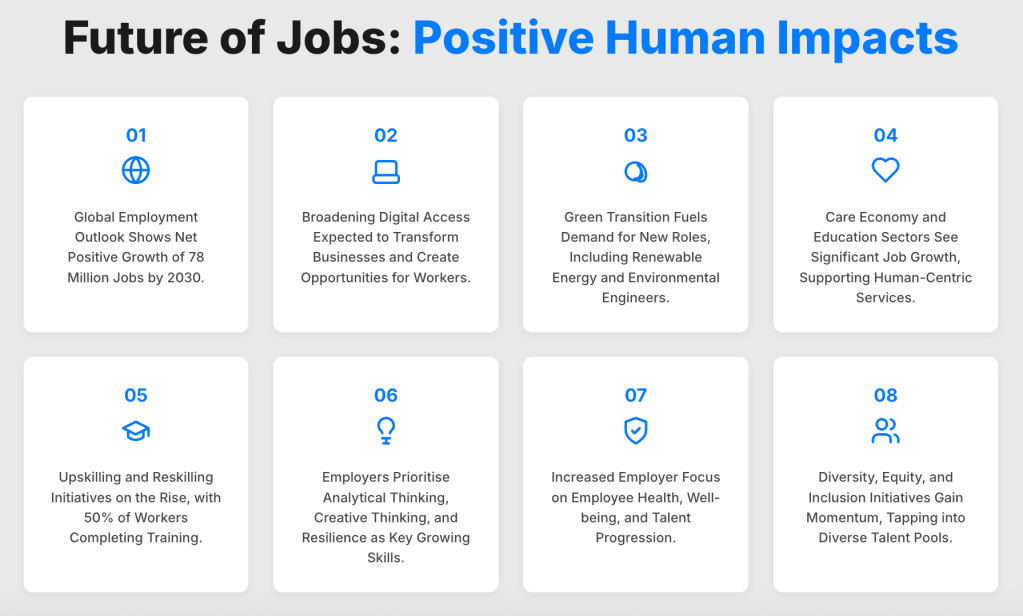
1. Global Employment Outlook Shows Net Positive Growth of 78 Million Jobs by 2030. The report forecasts a significant expansion in the global workforce, with a projected net growth of 7% in total employment, equivalent to 78 million new jobs by 2030. This substantial increase in job opportunities offers promising prospects for individuals worldwide, signalling a more vibrant and accessible job market. The expansion is driven by various factors, including technological advancements and evolving economic landscapes, collectively contributing to a healthier employment ecosystem.
2. Broadening Digital Access Expected to Transform Businesses and Create Opportunities for Workers. Digital access is identified as the most transformative trend influencing the future of jobs, holding immense potential to reshape industries and create new avenues for employment. As digital infrastructure becomes more widespread, individuals gain increased access to information, tools, and markets, fostering innovation and entrepreneurship. This digital transformation is set to empower workers with new skills and open up diverse job roles, bridging geographical and socio-economic divides.
3. Green Transition Fuels Demand for New Roles, Including Renewable Energy and Environmental Engineers. The global shift towards climate-change mitigation is directly driving demand for a new generation of green jobs. Roles such as renewable energy engineers, environmental engineers, and electric and autonomous vehicle specialists are among the 15 fastest-growing professions. This trend signifies a positive human impact by creating meaningful employment opportunities in sectors critical for environmental sustainability, allowing individuals to contribute to a greener future while advancing their careers.
4. Care Economy and Education Sectors See Significant Job Growth, Supporting Human-Centric Services. The report highlights substantial growth in human-centric sectors, with ageing populations driving demand for healthcare jobs like nursing professionals, and growing working-age populations fuelling education-related professions, including higher education teachers. Furthermore, care economy roles such as social work and counselling professionals, and personal care aides are expected to grow significantly. This expansion indicates a positive societal shift towards valuing and investing in services that directly enhance human well-being and development.
5. Upskilling and Reskilling Initiatives on the Rise, with 50% of Workers Completing Training. A significant positive trend identified in the report is the increasing focus on workforce development, with 50% of workers having completed training, reskilling, or upskilling measures – a notable increase from 41% in the 2023 edition. This demonstrates a strong commitment from both employers and individuals to adapt to evolving job requirements. These initiatives empower workers to remain competitive, transition into new roles, and enhance their career prospects in a dynamic labour market.
6. Employers Prioritise Analytical Thinking, Creative Thinking, and Resilience as Key Growing Skills. Beyond technical proficiencies, employers are increasingly prioritising core cognitive and adaptive skills for the future workforce. Analytical thinking remains the most sought-after skill, with 70% of companies considering it essential, complemented by the rising importance of creative thinking, resilience, flexibility, agility, curiosity, and lifelong learning. This emphasis highlights a positive human impact by valuing inherently human capabilities that foster adaptability, problem-solving, and continuous personal and professional growth.
7. Increased Employer Focus on Employee Health, Well-being, and Talent Progression. Supporting employee health and well-being is emerging as a top strategic focus for talent attraction, with 64% of employers identifying it as a key strategy to increase talent availability. This commitment extends to talent progression, as employers plan to allocate a greater share of their revenue to wages by 2030 and transition staff from declining to growing roles. This signifies a positive shift towards more supportive and employee-centric work environments, benefiting overall workforce satisfaction and productivity.
8. Diversity, Equity, and Inclusion Initiatives Gain Momentum, Tapping into Diverse Talent Pools. Diversity, equity, and inclusion (DEI) initiatives are becoming increasingly prevalent, with 83% of employers reporting such programmes in place, up from 67% in 2023. The report also notes a four-fold increase in employers (47%) recognising the potential for expanding talent availability by tapping into diverse talent pools compared to two years ago. This growing emphasis on DEI fosters more inclusive workplaces, ensuring equitable opportunities for all individuals and leveraging a wider range of perspectives for innovation and growth.
Here’s the full report if you are keen to go deeper.
James Stewart




 Humans in the Loop
Leave a comment